Intermedial reconstruction
Documents, images, audio and digital files are read in relation to one another in order to recover relationships, sequences and context across formats.
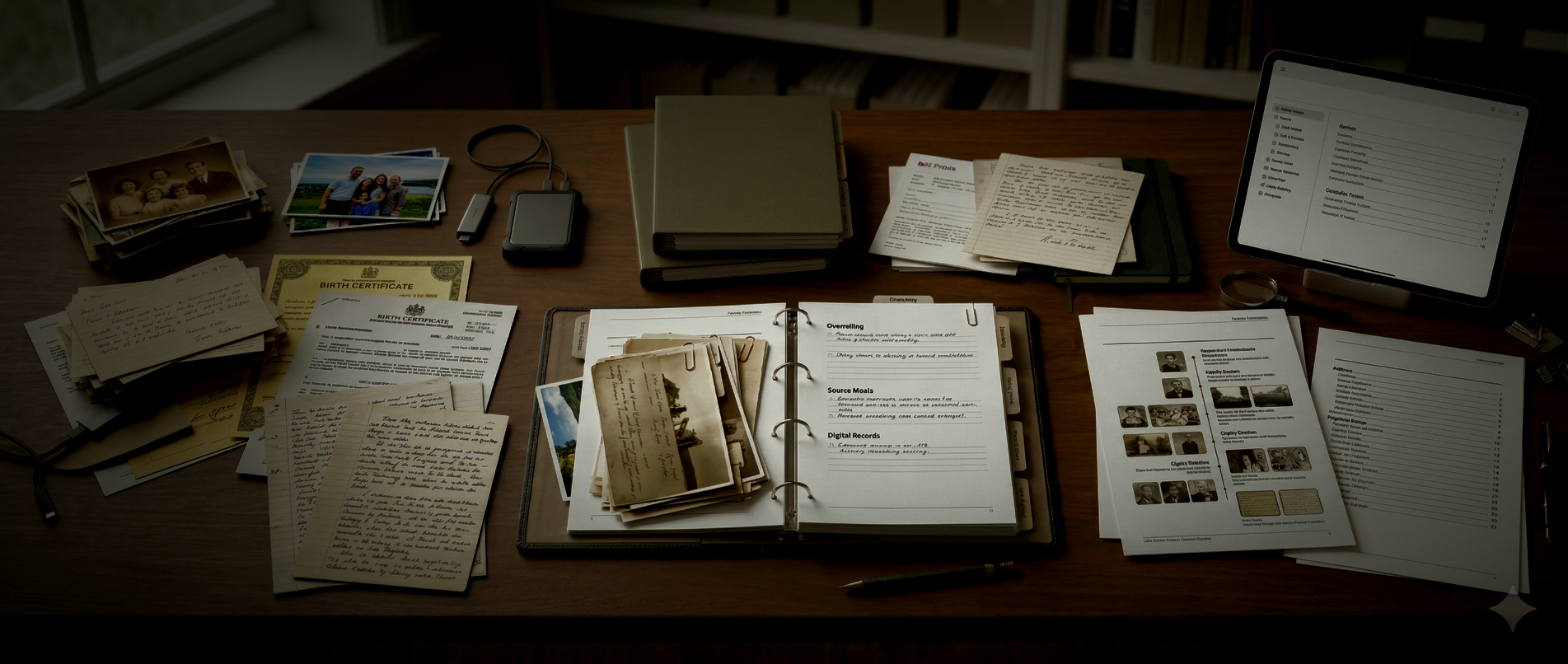
Independent private practice
Thiry Origin works with journalists, researchers and private clients on mixed archives, digital estates and sensitive case materials — especially where relationships have been lost or must be reconstructed under time pressure.
Working directly with journalists, researchers and private clients on sensitive and time-critical cases.
What this practice is for
Some collections are not simply disorganized. They have grown over years, spread across devices, folders, paper records, recordings and image collections, and their internal relationships are no longer easy to read.
This is where Thiry Origin operates: family archives, digital estates, research material, sensitive case files and other mixed source collections where chronology, relationships and context must be reconstructed across formats.
Methodological positioning
This is not simply genealogy, transcription or document sorting. The real work begins where scattered fragments become readable in relation to one another. A folder name may matter as much as a postcard. An email thread may explain an image sequence. A scan may confirm or contradict something claimed much later. The aim is not to manage individual media separately, but to reconstruct relationships across the collection as a whole.
Documents, images, audio and digital files are read in relation to one another in order to recover relationships, sequences and context across formats.
For cases where names, dates, roles and links must be reconstructed from complex, contradictory or multilingual material rather than lifted from simple lookups.
Smartphone exports, hard drives, mixed folders and USB media are turned into usable structure rather than remaining as unreadable digital residue.
Scans, image series, older and newer photographs, and visually inconsistent folders are reviewed, renamed, grouped and linked back into the wider archive logic.
Statements, dates, claims and remembered sequences are checked across sources in order to surface patterns, confirmations and inconsistencies.
The result is not only a processing step but a usable end form: chronology, archive index, linked source groups, HTML dossier, transcript bundle or structured report.
Who this work is for
Thiry Origin is particularly suited to direct collaboration with journalists, researchers and private clients when collections are complex, mixed-format, sensitive or time-critical.
For sensitive or time-critical investigations in which files, recordings, scans, images, notes and digital traces must quickly become a reliable and navigable structure.
For projects requiring cross-format reconstruction, chronology building, linked holdings, multilingual processing and dossiers prepared for analysis, review or publication.
For digital estates, family archives and personal collections that require durable structure, reconstructed relationships and usable outputs rather than partial sorting.
Working across formats
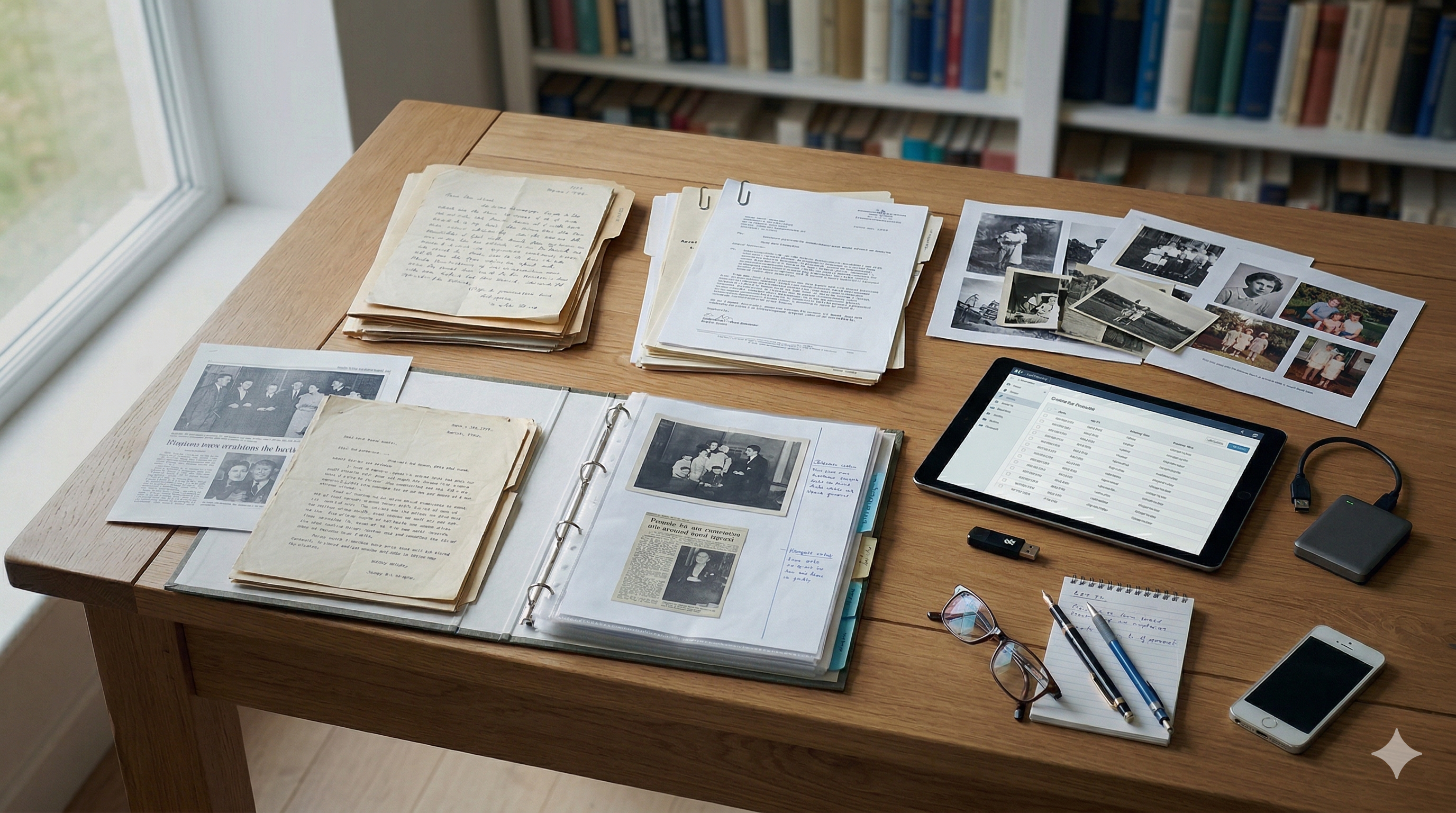
A complex collection is rarely monomedial. It may be spread across paper records, scans, email, exported photographs, PDFs, voice messages, video fragments and older storage media.
The key question is not which format is primary, but how the parts relate to one another across time, context and origin. The aim is to turn scattered data points into a connected and traceable body of material.
Structured source analysis
This addresses practical problems directly: image folders need consistent naming, unlabelled scans must be classified, mixed PDFs must be ordered, and contradictions must be checked. A disordered file mass is turned into a usable system.
The focus is on functional organization with analytical depth. This is not cosmetic file sorting, but the reconstruction of meaningful relationships across formats.
Services
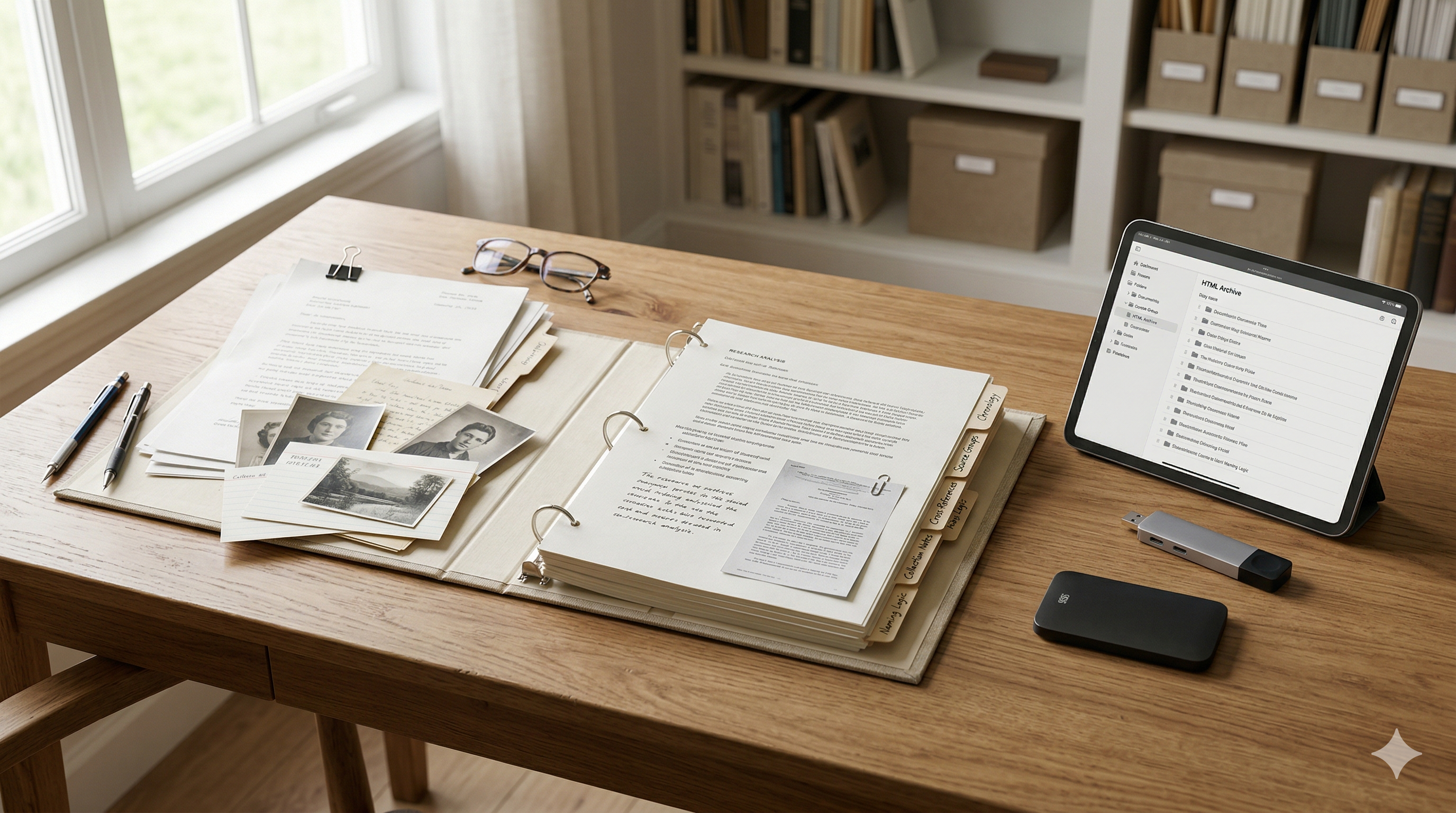
These areas rarely stand alone. Most projects require cross-format reconstruction and combine document classification, chronology work, multilingual analysis and the handling of substantial audio or image holdings within a single workflow.
For estate, family and research contexts in which names, dates, roles and sequences must be reconstructed from incomplete, contradictory or multilingual material.
Smartphone exports, hard drives, mixed folders, unstructured PDFs, email threads, photos and video are brought into clean, usable order without reducing the work to simple data recovery.
Chaotic image directories, large scan archives, PDF bundles and graphic source material are systematized, named and linked into wider chronology.
Suitable both for isolated recordings and many hours of spoken material, including transcript excerpts, timestamps and direct integration into dossier context.
Statements, datings, claims and remembered sequences are compared across sources in order to reveal confirmations, temporal patterns and structural contradictions.
HTML dossiers, archive indexes, linked datasets, timelines, PDF packages and print-ready reports make the material fully usable again regardless of its original format.
Context and distinction
Thiry Origin is an independent private practice operated by David Liam Thiry in a personal capacity.
David Liam Thiry is also the founder, management board president and developer of R2 Mechanics sp. z o.o., which began operating in Poland in 2026.
R2 Mechanics focuses on the technological processing of audio and video sources, offline-first pipelines, structured archival outputs, reproducible workflows and the supporting infrastructure for demanding analysis and archival concepts in institutional and business contexts.
Thiry Origin serves a different segment: a private practice for reconstructing mixed collections, digital estates, family research, chronology work and project-based support for journalists, researchers and private clients.
This means that technical expertise, infrastructure background, methodology and location may overlap in part. At the same time, Thiry Origin and R2 Mechanics sp. z o.o. operate in distinct fields and are clearly separated in economic, contractual and partnership terms.
The services presented on this website are offered exclusively through Thiry Origin as a private practice and not through R2 Mechanics sp. z o.o.
Process
The goal is to restore readability and usability through precise classification, linking, chronology building and source-based organization. Depending on the project, this may include many hours of audio, large scan holdings or digital archives that require both speed and high structural care.
The material is assessed by type, condition, naming logic, chronology and possible internal relationships.
Sources are organized into intelligible categories, clusters, timelines or dossier sections.
Cross-format relationships are reconstructed and made explicit: image to note, folder to chronology, transcript to medium, statement to contradiction.
The result is turned into a usable end form: index, chronology, linked dossier, structured HTML or verifiable report.
The work relies on the factual basis of the records and holdings, not speculation or narrative embellishment.
Different media types are treated as connected sources, not isolated silos.
Multilingual collections are handled as connected units; language boundaries are part of the material itself.
Sensitive data remains within closed and controlled workflows rather than generic cloud platforms.
All outputs are designed for traceability, navigation, review and operational use.
Careful case-based project work rather than anonymous bulk processing or unstructured digitization.
Usable end formats
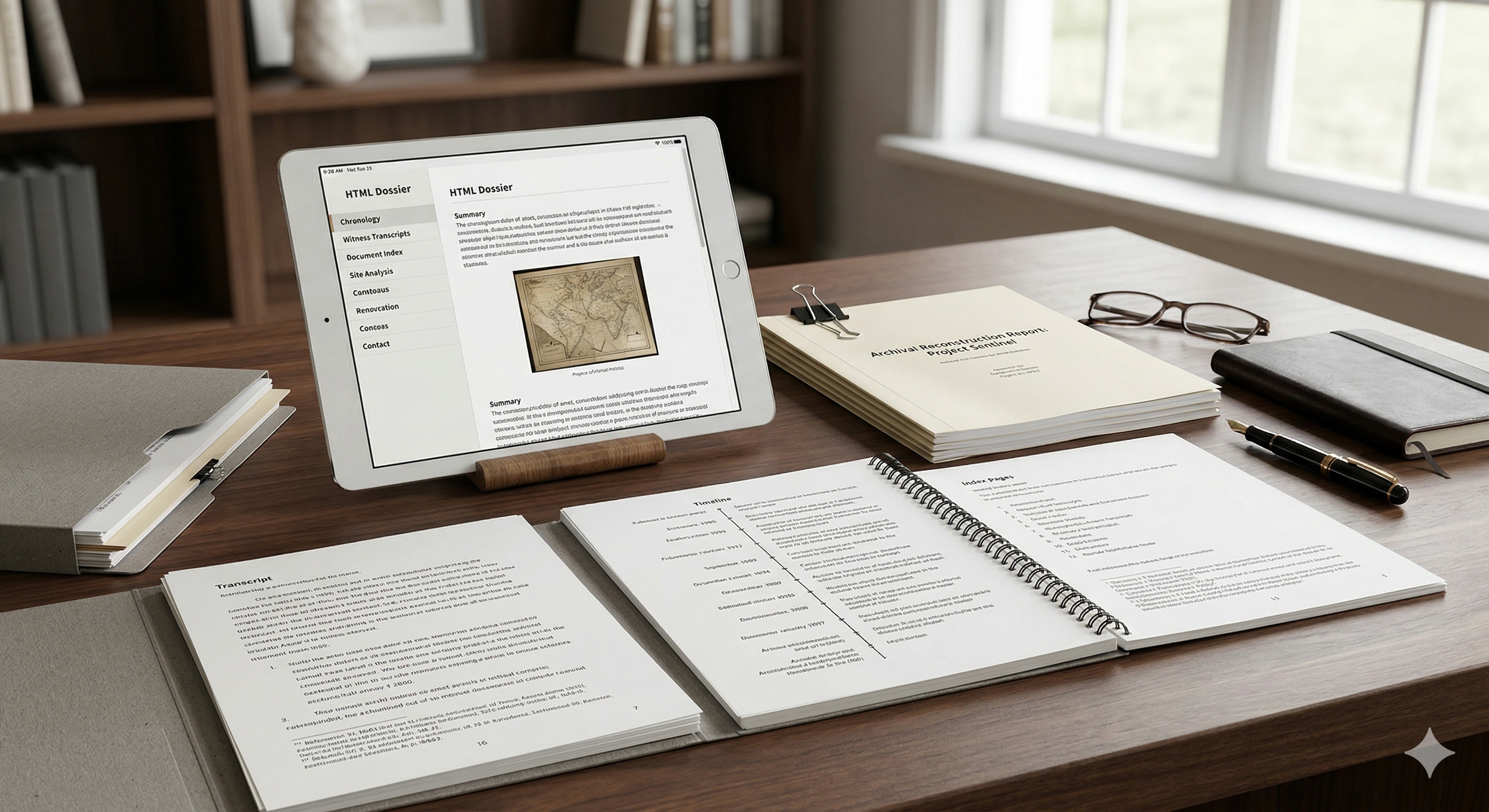
The result is not an intermediate step but a structure with immediate use: readable, reviewable, searchable, ready for handover, archiving or further work.
Infrastructure, data security and transfer
Thiry Origin is designed for engagements that require more security and control than a standard third-party upload. Processing can take place through independent server structures configured for mixed media, larger volumes and demanding source collections, including many hours of audio, large scan archives or high-resolution image holdings.
The technical infrastructure is designed for independence, controlled processing and reliable delivery. This makes cross-format linking and multimodal processing possible even for sensitive collections, without unnecessary dependence on external platforms.
Material can be transferred digitally through controlled uploads to independent servers or physically by post or courier when paper archives, hard drives, analogue carriers or large material volumes are involved. Final delivery can likewise be digital or physical. Deletion protocols for source data and working copies are implemented reliably at project completion.
Contact
For an initial assessment, a short description of the material, its approximate volume and current condition is sufficient, whether the case involves audio recordings, scan archives or digital fragments.
Inquiries from journalists, researchers and private clients are handled directly, especially in time-critical or sensitive cases requiring precise, discreet and efficient preparation.
Material transfer can take place digitally through independent server structures or physically by post or courier where analogue carriers or paper archives require it.
All projects can be carried out under clear deletion protocols and defined post-delivery requirements.
Initial inquiries may be submitted in German, English, Polish or French.
Email: hello@thiryorigin.com
Location: Poland
Particularly suited for: journalism, academic research, digital estates, relationship reconstruction, family archives, mixed media collections, complex chronologies and document-intensive dossier projects
Helpful in advance: material types, estimated volume, languages present, the primary project goal such as reconstruction, classification, chronology, contradiction analysis or dossier creation, and whether digital or physical transfer is preferred